Showing posts with label IBM. Show all posts

Sunday, October 28, 2012

Apple, SAP & Hewlett-Packard: Not Just Numbers, Company's Vision, Strategy and Goals Also Matter For Investors (Part II)

Part I of this two-part blog offered empirical evidence suggesting that few consistently outperforming technology companies (such as AAPL and GOOG) get valuation treatments that defy conventional wisdom.  Part I ended by introducing an investment approach that was based on three simple rules and suggested that management's effectiveness in articulating its corporate vision and goals and its trustworthiness also plays a critical role in winning investors' sentiment.  Let's put each company through this test in part II of this blog and discuss the outcome.

First up, AAPL:  For AAPL, I can safely conclude that the first two rules are securely in the bag.  Investors understand the company and its hugely popular products.  It has successfully sailed with the wind for the past decade and I might even argue that it brought fresh wind in the sails of tablets and smart phone segments.  But when it comes to applying the third and final rule, i.e.  investing in AAPL for the mid-to-long term, and thus paying a reasonable multiple, investors are certainly hesitating to act.  From investors’ point of view, the investment decision boils down to following two points:
  •  AAPL gets fresh lease of life every year when it upgrades its iLine (iPads, iPhones, iPods and Macs) of products;
  • But other than this routine, AAPL management is highly secretive about its vision for the future of AAPL.
For AAPL investors, it is challenging to see beyond a one year horizon.  The investors are asking larger questions to AAPL including:  a) what does AAPL want to be in 5 years and where will it be?  b) Will AAPL dominate some market segments as it does today, if so, what is that longer-term strategy?  Until, AAPL addresses these questions and clearly articulates its strategy and the goals tied to its strategy, it will be hard to see why investors would apply SP500 like or higher multiples on AAPL.

Next up, ORCL: For ORCL, I would start by arguing that ORCL is suffering from a credibility problem with the investors.  Investors get ORCL’s enterprise software and hardware business which is attractive and growing at a secular rate.  ORCL has accepted that inorganic growth model (via acquisition) is the way to move its business forward and stay current on the technology innovation front.   Besides all this, its earlier position on cloud technologies (calling it a fad) and then turning into a true cloud believer (with the acquisition of RightNow, Taleo and its own investments) has sent mixed messages to investors. 

ORCL has done a poor job of laying out its long-term vision for investors and investors are unhappy because they are unable to see a clear path forward.  Does ORCL want to be like its big brethren IBM and package hardware, software, services and cloud infrastructure together for its customers?  What does ORCL want to be?  What are some of its growth plays?  ORCL has attempted to articulate its vision to investors and analysts but the reduced trustworthiness and the past delays in strategic investments have kept investors skeptical at best.  ORCL needs to win the credibility back from its investors and shy away from sending mixed messages to investors and its own customers.

Next up, HPQ:  I don’t know where to begin with this company.  Let’s start at the very top, the board. HPQ’s board has had major credibility issues for many years now because of the scandals and terrible decisions that have resulted in billions of dollars of losses for investors.  The epic stumbles such as the launch of Palm based tablets/smart phones (and then the immediate pull out), public display of flip-flopping decisions on spin-off for Personal Computer unit and then having three CEOs at the helm of HPQ in less than three years has not pleased investors. 

In addition, HPQ’s core businesses continue to suffer resulting in heavy losses because it has been slow to respond to the shift in technology spending to cloud and mobile technologies.  HPQ’s market cap has dropped by more than 80% since peaking at approximately $120B in 2010.  Investors have little to no confidence in HPQ and are pricing in rapid erosion of its customer base and sales (which is reflected in a low price/sales ratio of 0.23.)

Next up, GOOG:  GOOG has wide range of interests resulting in a large array of investments including the investment in driver-less cars.  Not all the projects GOOG has undertaken in recent years have been positive NPV projects and as a result GOOG’s stock has same P/E multiples as that of SP500.  GOOG wants to be a technology company and all the investments GOOG makes have this common origin.  This is a fact but why investors are not comfortable with it?  Is GOOG not effective at convincing investors that this approach is right and will bear fruits?

Is GOOG going to be a media company, or a mobile company, or a hardware company, or an Internet bandwidth company, or a search company or an enterprise software company or all of the above (i.e. a tech conglomerate)?  Apparently, GOOG’s vision and  roadmap are not very clear to investors which is why GOOG had lackluster performance for the first six months of 2012 prior to Q2’s earnings announcement.  I believe that investors have adopted a wait and watch approach on GOOG which is a mature company now but surrounds itself with a high number of uncertainties.

Next up, IBM:  IBM is securely in the bag using the rules I laid out in Part-I.  By 2015, IBM will generate $20 in non-GAAP EPS - this is IBM’s corporate goal for 2015.  I believe that investors should love the simplicity of IBM’s singular goal.  IBM has done a nicejob in articulating its corporate goal for 2015 including the key growth plays that will drive IBM forward to its goal.  The key growth plays from IBM are emerging markets, Analytics, Cloud and Smart Planet initiatives.  IBM has also articulated that it will pursue higher-margin opportunities (i.e. software) and use share repurchase programs to boost EPS.  IBM’s EPS in 2011 was $13.4 which would have to rise by 50% in 4 years if IBM were to accomplish its goal of producing $20 EPS by 2015.

Both AAPL and IBM are iconic and trusted brands.  IBM has provided a clear vision and a path forward but AAPL has not, therefore I am not surprised to see that both IBM and AAPL received similar Trailing and Forward P/E multiples despite the fact that AAPL’s earnings growth is nothing less than spectacular.

This brings me to the last company I will discuss here, SAP:   Just like IBM, SAP is also securely in the bag.  SAP is a global brand and plans to reach 1 billion people in an attempt to become a household name.  I have found SAP to be a goals driven company and it is taking all the necessary steps (both organic and inorganic growth opportunities) to track towards these goals.  This is similar to IBM’s approach but more clearly spelled out.  Here are the goals that SAP has laid out for 2015 on its corporate website:

Source: SAP' Corporate Website

Additionally, just like IBM, SAP has also clearly articulated its growth strategy and the five market categories it plans to expand into.  These categories are: applications, analytics, mobile, database & technology, and the cloud.  SAP’s management has not sent mixed messages to the market (unlike ORCL) since sharing its vision and goals for the future and is gearing up to ride both the mobile (with Sybase and Syclo acquisitions) and the cloud trends (with SuccessFactor and Ariba acquisitions).  

SAP is not the only company growing its revenues at a double digit rate for more than 10 quarters, but it is logging that performance on a consistent basis and tracking towards its 2015 corporate goals.  Investors are cheering this steady performance and have bid up the stock by more than 35% YTD in 2012, higher than every other stock in the group except AAPL (see the graphics below):
  
Source: Google Finance

Majority of the public companies, if not all, develop a vision, lay out a clear strategy and announce goals to realize that vision.  But some do a better job than others in articulating and sharing this on a regular basis with their investors.  Companies that clearly articulate their vision and strategy to all their constituents including customers, employees, partners and investors earn respect almost instantaneously.  And when these companies publicly track progress against their vision, they benefit tremendously by winning the trust and credibility from each and every constituent (including investors) allowing them to attract top talent, new customers, new partners and new markets to help them grow their business. 

This blog has benefited from the discussions with my friends and colleagues Jens DoerpmundRyan Leask and Rajani Aswani on this topic.

Disclaimer:  All numbers are approximate and the underlying analysis is preliminary.  This blog is not intended for offering any investment advice.  SAP is my employer but all the views and opinions expressed here are solely mine.

Apple, SAP & Hewlett-Packard: Not Just Numbers, Company's Vision, Strategy and Goals Also Matter For Investors (Part I)

In this two-part blog, I will share my view points on why investors price certain stocks at higher or lower multiples against market defying conventional wisdom which suggests that higher (lower) growth stocks should fetch higher (lower) multiples than that of the market.  

In part I of this two-part blog, I offer empirical evidence suggesting that few consistently outperforming technology companies get valuation treatments that defy conventional wisdom.  Faster growing companies get lower multiples while slow and steadily growing companies get higher multiples.  

In part II of this blog, I will conclude by suggesting that a clearly articulated long term strategy along with measurable corporate goals play an equally important role together with the company’s financial track record and market beating performance in winning investors' heart (and getting higher multiples.)  

To help me illustrate my view points, I assembled a small group of traditional tech companies including Apple (Ticker: AAPL), Oracle (Ticker: ORCL), Hewlett-Packard (Ticker: HPQ), Microsoft (Ticker: MSFT), IBM (Ticker: IBM), SAP (Ticker: SAP), and Google (Ticker: GOOG).  I selected S&P 500 (SP500) as the market.  

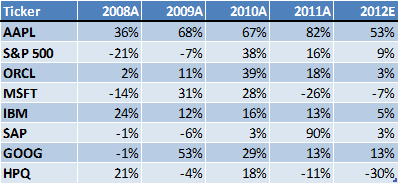
As of Oct 19, SP500’s Trailing P/E and estimates for Forward P/E were 17 and 13.8 respectively (see the side table.)  AAPL’s 52-weeks return of 50.5% has markedly outpaced the same period return of 9.95% for SP500.  In addition, AAPL’s earnings growth has substantively outpaced that of SP 500 for five straight years (see the side chart). So I started to wonder why AAPL’s Trailing and Forward PE multiples of 14.3 and 11.4 trail that of S&P 500 (see the table below).  Is there a crisis looming for AAPL that could be bigger in magnitude and impact than those faced by the financial markets including the never-ending debt crisis in Europe, a worsening slowdown in China and an already unraveling fiscal cliff in the US.  So, why are investors not pricing AAPL using the multiples of SP500 at the minimum?

Consider SAP:  In a peer group comprising of  four enterprise software tech companies - SAP, IBM, ORCL and MSFT, SAP has the highest Trailing P/E and the highest Price/Sales ratio (see the table below).  SAP’s Forward P/E of 19.7 is 9 points higher than that of ORCL, 11 points higher than that of MSFT and 8 points higher than that of IBM.  In addition, SAP’s Forward and Trailing P/E multiples are also higher than that of SP500!  So, why investors are willing to price SAP stock at higher multiples than the others in its peer group including the SP500.  Interestingly, SAP’s multiples are also higher than that of AAPL.  


Finally, let’s drop HPQ into the mix:  HPQ’s TTM revenue was $61.9 per share (see the table above).  Its stock is trading at a meager P/S multiple of .2x and has a Forward P/E multiple of just 4.  This is not hard to explain as there is no love left between HPQ and its investors who have suffered heavy losses in HPQ which has dropped almost 50% just this year alone.  In addition, at such lower multiples, investors are definitely pricing in a catastrophic scenario.

Source: Morning Star and Yahoo Finance
For all these companies, I assembled last 5 years income statements and I reviewed their revenue growth rates (see the side table).  Nothing jumped out that could have suggested why AAPL should have lower multiples than the SP500, GOOG or  SAP.  Clearly, there is something else at play which traditional valuation approach is not explaining.


Investors’ actions in HPQ, AAPL, SAP and its peers can be justified by applying following three simple rules of investment: 
  1. invest in companies you know, understand and believe;
  2.  invest in companies which are going to persist, pursue positive NPV projects and successfully sail with the wind (market trends); &
  3. invest in companies for mid-long term.
 Investors closely scrutinize, more than one would desire, the company management’s effectiveness in articulating its future and corporate goals and the trustworthiness.  This is where the “believe” part in the first rule comes in.  In part II of this blog, I will apply this set of principles to few companies in this group and discuss the outcome.

This blog has benefited from the discussions with my friends and colleagues Jens DoerpmundRyan Leask and Rajani Aswani on this topic.

Disclaimer:  All numbers are approximate and the underlying analysis is preliminary.  This blog is not intended for offering any investment advice.  SAP is my employer but all the views and opinions expressed here are solely mine.

Wednesday, February 15, 2012

You Get What You Pay For - Tale of Two Acquisitions - SAP-SFSF and ORCL-TLEO

Two months ago, SAP made an offer to acquire SuccessFactors("SFSF"), the leading cloud based Human Capital Management ("HCM") company for $3.4B, a multiple of 10.2 on 2011 on expected 2011 revenue of $332M.  I published the following two blogs on this development back in December:


Salesforce followed suite and acquired Rypple, a company that employs badges and achievements to imbue the employee review process with a collaborative, social media-like experience.  Financial terms were not disclosed. (Source: EnterpriseAppToday)

Oracle was long due after the RNOW acquisition and it decided to follow SAP (for the first time) and Salesforce by acquiring Taleo ("TLEO"), the #2 company in the business, for $1.9B, a multiple of 6.15 on 2011 revenues of $309M. (Source: BusinessWeek)

As usual, folks are reaching out and saying whether SAP's SFSF acquisition is expensive due to a higher multiple it paid to SFSF shareholders and whether it rushed in too early.  I don't believe that SAP's SFSF acquisition is expensive by any stretch of the imagination.  "You get what you pay for" - this notion is quite true in this case. 

The business rationale SAP announced when it made the decision to acquire SFSF was that SFSF is:
  • #1 HCM solution in the cloud
  • has 15m users from company of all sizes (SalesForce has only 3m users) in diverse 60 industries from across the globe (Example: Siemens has 450K seats)
  • 3,500 customers in 168 countries
  • 60% recurring revenues from existing customers
  • 90% of the growth is organic as oppose to Salesforce
  • Has just 14% overlap with SAP customers – a tremendous upside for both companies (with total addressable market of 500m employees of all SAP customers)
On the other end, this is what TLEO disclosed it has: 
  • one of the world’s largest cloud deployments with nearly 16 billion transactions per year
  • manages 15 percent of all hires in the US 
  • has a customer base comprised of 5,000 businesses 
  • its Talent Exchange boasts 240 million candidates 
  • of the top 30 career sites, nearly half are powered by its technology.
(Source: Taleo)


The two companies can hardly be compared on these business metrics, so I am going to focus purely on financials.  SAP put a forward multiple of 8 on SFSF's expected 2012 revenues of $420M while Oracle is paying a forward multiple of 5 on TLEO's expected 2012 revenues of $379M.  There is this informal "rule of thumb" in place that states that one should pay a multiple of six to eight times of forward earnings for acquiring growth companies. 

Through following series of comparison charts, one could clearly see why SFSF will fetch a higher premium over TLEO.  Everything boils down to just couple of financial metrics and these metrics are: growth and operational efficiencies:


1. SFSF is a better growth story with CAGR more than DOUBLE than that of TLEO:


2. SFSF has far better cost structure than TLEO even though SFSF has grown revenues more than TWICE as fast:


 3. SFSF has somewhat better operating structure and is rapidly becoming more efficient with every dollar it spends on its operating cost. TLEO has done a good job of keeping its cost structure the same, one must wonder, why TLEO is not becoming operationally more efficient:

4. Making money from the cloud apps has been very tough business but this is very quickly starting to change as economies of scale kick in and both companies improve their net-income. SFSF definitely has done a good job in trimming its losses: 


5. The last two charts just compare the growth in revenue for the two companies since inception:


The bottom line is that SFSF is a better growth story and is operationally more efficient than TLEO so a higher multiple for SFSF is fully justified in my opinion. 

Did you know that, Oracle paid a multiple of 10x on Endeca's 2011 revenues? It is not just other companies (SAP or HP) that pay a forward multiple of 10x.
“Though Oracle and Endeca haven't talked about the acquisition price, I reported in October that California-based Oracle had agreed to pay $1.075 billion for the company (based on a document I obtained related to the deal).” (Source: boston.com

Happy Browsing!

Wednesday, February 1, 2012

Big Four and the Battle of Sentiments - Oracle, IBM, Microsoft and SAP

In this battle of sentiments or opinions for the four software giants - Oracle, IBM, Microsoft and SAP, SAP is generating a lot of positive buzz with its message of "innovation without disruption" and leading the pack with a 95% sentiment score.


TagTweetsFetched+ve Tweets-ve TweetsAvg.ScoreTweetsSentiment
@IBM19849450.0819452%
@Microsoft893307780.48438580%
@Oracle29790170.31310784%
@SAP985530.6735895%


Few days ago, I published this blog "Updated Sentiment Analysis and a Word Cloud for Netflix" and the underlying R code.  I used the same R program to compare the sentiments for the four software giants.  Now, technically speaking, IBM and Oracle are not pure software companies anymore since they both package hardware (server and storage hardware) along with the software but the rivalry between these four companies persuaded me to put a comparative analysis  here.  I originally included HP in this analysis but then dropped it as I didn't consider HP in the same league as these fours in the software category.

What surprised me the most was the lowest score IBM received, lower than Oracle!  What went wrong here?  I am also surprised to see Oracle occupying the second spot with 84% sentiment score.  So besides all the negative publicity Oracle attracts, the sentiment is overwhelmingly positive.

The one improvement I would like to make to this analysis is to get more tweets.  Twitter API restricts the number of tweets that one can fetch and doesn't allow you to fetch older tweets.  I would love to run this analysis over a year worth of tweets and also show a time series of sentiment score.  That will be fantastic!

Here are the four histograms, one each for four candidates, showing the distribution of opinion scores:


SAP


IBM


Microsoft


Oracle


Happy Analyzing!


The underlying data can be downloaded here.


Wednesday, December 21, 2011

Enterprise Software Spending to Slow Down - Business Analytics to the Rescue?

Few months ago, I floated this hypothesis that the software spending generally has a lag of 1-2 quarters to hardware spending and given that hardware spending is slowing down now with Cisco, Juniper, Brocade, EMC, NetApp, (and chip companies prior to that) all coming out with revenue and EPS warnings, software spending could slow as well further down the road.

Now, if ORCL’s  warnings from last night and following quote from an analyst were to be taken seriously, this hypothesis is unfortunately is coming true.  

                   Jason Maynard, an analyst at Wells Fargo Securities, said in a Dec. 19 report that corporate spending on hardware and software may fall 8 percent in the first quarter, a steeper drop than the average 7.3 percent average decline during the quarter in the past 10 years. (Source: Business Week )


The Enterprise Software Industry has enjoyed 12-13 quarters of continuous growth and it is a well-known fact that the spending is cyclical in nature.  May be, the industry should prepare for couple of quarters of slow growth (or no growth.) 

I am off the opinion that a full blown contraction in software spending will not occur. There is a pent up demand and those demand dollars are shifting to the cloud for SaaS, PaaS, IaaS and all other types of aaS as these XaaS become a preferred choice. That is precisely what may have caused the bloody hiccups (the reaction on Oracle's stock in financial markets) at Oracle.

This may be just an aberration for the tech industry and it may require new economy companies to prove that is just an aberration and not a trend . (Please see this blog - Oracle earnings - an aberration or a trend? )

Coming to the Analytics topic - in good times or bad times, more so in bad times, business analytics has become a tool of necessity, a must-have weapon to understand what levers to pull to run the business more effectively, more efficiently and identify the right resources to be delivered to grow and optimize the business in tough times.  


Data is a strategic asset and Business Analytics provides tactical tools to exploit that asset, companies will mine data even deeper with more sophisticated tools to get even more deeper insights if the signs of slow down loom on the horizon.

It is yet to be seen that the business spending on analytics will slow as well.  I will take a different stance here and will form another hypothesis that the spending will likely increase over the next couple of quarters.

Monday, December 19, 2011

Mobile Analytics - A Game Changer!

Mobile Analytics (a.ka. Mobile BI) has been the hottest strategic topic and a top focus for many enterprise software organizations as customers, small and large, grapple with the big data onslaught and throw everything at it to become even more efficient, both on top-line growth and bottom-line optimization, in an economy struggling to grow and a continent unable to stop a contagion from spreading and once again threatening the global economy.  

Customer's perennial struggle and in-turn a cost-saving approach translates into big analytics opportunity for enterprise software companies to shift customers from traditional analytics solutions to Mobile and Cloud based analytics solutions.

On the premise explained above, I did a business case about 9 months ago to develop a FULL picture of Mobile Analytics market.  I used a ton of research and analyst reports and interviews and invested upwards of hundreds of hours to develop and present a complete story on Mobile Analytics including developing my own proprietary models related to assessing the size of this opportunity. 

I am summarizing my findings at a very high level in following bullet points and have made available the synthesis slides on slideshare (link is printed below).
  • Big Data - According to IDC, data is doubling every two years and is expected to reach 1.8 ZB (a trillion GB) in 2011.
  • Eight mobility related mega trends are locked in a virtuous cycle and will be the bedrock for growth and adoption of Mobile BI solutions and for  the overall Enterprise Mobility.
  • Mobile BI market could grow at 20% plus CAGR over the next 5 years and could likely become over a $2 billion market by 2015.
  • According to Gartner, more than 33% of Analytics will be consumed using mobile devices, a prediction well supported by the 8 mobility related mega trends discussed here.
  • Therefore, by 2015 more than 15% of Analytics revenues could come from Mobile Analytics solutions. This should be a serious strategic priority for every Analytics vendor if not already.
  • Advanced Analytics including geo-spatial for  Mobile Consumers is growing as computing power and form factor of mobile devices change rapidly. 
  • Shift to “active production model” from a “passive consumption model”  is expected to happen allowing mobile business users to assemble dashboards and produce/edit reports on the go.
Download slides from Slideshrae - Mobile Analytics (Mobile BI) - A Game Changer

Special thanks goes to Gartner, IDC, Boris Evelson of Forrester, Cindy Howson of BI Scorecard, and Howard Dresner of Dresner Advisory Services for producing excellent research on this topic and answering all my questions and to all my colleagues and friends across the world. 

Upcoming blog on Agile Analytics

Tuesday, May 31, 2011

Business Analytics Market - Ripe for M&A Opportunities?

This is not a recommendation to buy any of the companies I am mentioning here. I am just sharing my opinion on potential M&A opportunity in Business Analytics space. The companies in highlighted rows present could be a target of M&A this year. (Click on the image to enlarge it.)


Who could buy: HP, IBM and Oracle (or may be Dell) will likely acquire them in 2011.
There may be some mergers between INFA/QLIK or TDC/TBX or TDC/MSTR or MSTR/INFA or INFA/TDC to build a stronger company and to offer complete business analytics solutions. 


Also see my other post on emerging and fast growing companies in Analytics space.

(Disclosure: I don't have any position in any of the companies.)

Wednesday, May 25, 2011

Does your company have a BI implementation plan? Consider this statistics:

  • According to market research firm IDC, annual data generation will reach 35 zettabytes or about 35 million petabytes by 2020. 
  • That is enough data to fill a stack of DVDs reaching halfway to Mars, or 17.5 million times the entire collections of all the academic libraries in the United States. 
  • As a result, business intelligence has become an eight billion dollar industry and continues to increase each year. Global Industry Analysts released a report in July projecting the BI software market will reach $12.4 billion by 2015.
  •  In May, Forrester came out with a report on the state of the BI industry, finding 49 percent of companies are planning a BI project in 2010 or soon after.
I think that the BI market is expected to be bigger than what IDC is projecting based on my own experience, analysis, research trends and continuous work with BI think-tanks. There are lot of other trends like location analytics and predictive which will make BI even more pervasive in next 2-3 years. 

Now, this ties pretty neatly into my earlier blogs on Big Data and huge amount of innovation happening in this space. Keep blogging... (See my blog entry from February 2010)

A crowded Mobile Analytics (Mobile BI) Competitive Landscape - Is the opportunity really that big?

Quite a few challengers in the market. The following list is a just a first stab at the number of companies looking to capture a piece of the action. The Mobile Analytics market is going to be a big opportunity which also nicely ties into the Big Data story and the Enterprise Mobility trend. More on the size of the opportunity and mobile analytics trends later. For now enjoy this graphics I built using the Dresner study -


Also see the magic quadrant from Gartner on BI. Some overlap between the companies on the two graphics indicating that there are new challengers on the market like LogiXML and Bitam. See my earlier blog on HTML 5 on LogiXML - 


Tuesday, May 24, 2011

Growing Bigger - QlikView Faces Headwinds? One Analysts Thinks That is the Case.

QlikView (Ticker: QLIK)  has been a poster child of BI since 2006 growing at a record double digit pace and becoming the envy of many large BI players (by not direct competing with them but still out-pacing on sales and customer growth). Many executives at large firms (un)proudly speak of QlikView as a strong competitor. Pretty good achievement!
 Take a look at the following graphics below that captures all company vitals - 


As QLIK grows, it faces an interesting challenge as faced by every company standing at the gates on an inflection point - transitioning to a larger company. Here are some of the issues identified by identified by Gartner for QLIK - ( I am pretty confident that QLIK will continue to execute well in near-term but it definitely has to resolve all of these issues mentioned below) 

QlikTech offers limited metadata management. As QlikView grows into larger BI deployments spanning the enterprise, the lack of an enterprise semantic layer becomes a more pressing issue. Filling this gap requires additional cost and effort in the management of metadata to lock down common definitions and calculations, and to conform dimensions for cross-functional analysis across QlikView applications.

QlikTech's focus on analysis and usability for end users delivers significant advantages. However, its lack of a number of broad BI platform capabilities (high volume enterprise reporting, planning/financially oriented OLAP, Microsoft Office integration, scorecarding and predictive modelling) means that it will almost always need to be used alongside another BI platform.

QlikView is increasingly seen as expensive — almost a third of its customers surveyed (31.4% vs. 26.1% in the whole sample) see this as its main barrier to wider use. Its pricing model often does not sit well with larger deployments to more users, nor does the investment in RAM required to support the increasing numbers of concurrent users.

Monday, May 23, 2011

IBM - Analytics is a very serious priority! How serious? $14B serious!

Actions speaks louder than words -  
- IBM has pent $14 billion on 24 business intelligence-related acquisitions over the past 5 years** (See the graphics below)
- It has 8,000 consultants in Analytics and Optimization service trained on BI***
- IBM earmarks $20B for acquisition through 2015 * 

Analytics is a priority at IBM for following reasons: 
- that spending on BI is growing twice as fast as information technology spending overall
- that 80% of CEOs see information as the source of competitive advantage. (Source: IBM and MIT Sloan Management Reviews)

Here is a latest press release that further reinforces the market's belief that IBM machine is not slowing down the big-data front - 

IBM Ups Big Data Bet with New Software, $100 Million in Research


Source: *,**,*** Public Press Release (IBM Accelerates Business Intelligence Acquisitions, Jeff Moad, Managing Automations, IBM Analyst Day, 2010)

Friday, May 13, 2011

Big Date Beneficiaries - Sybase, Netezza, Exadata and more!

So my last post was about big data. Let's talk what kind of companies are going to benefit from the data explosion and mind you, the big data opportunity can't be discussed in one single blog. Now, the big data story started in 2010 and there are already few beneficiaries:
  • SAP acquired Sybase;
  • IBM acquired Netezza; and
  • Oracle acquired Exadata.
Going into 2011, the big data story is only going to get bigger. Here is an article that I read earlier (from a series of such articles) that discussed 3 predictions for 2011 based on big data - 3 "Big-Data" Predictions for 2011

Prediction #1: Not all data is created equal. Traditional relational database management systems will be challenged in 2011. (other flavors of repositories including columnar, in-memory, Hadoop/MapReduce, and other NoSQL approaches made popular by Google, Facebook, and other large-scale Internet applications.)
Prediction #2: Cloud architecture deployments will grow, specifically for long-term data storage and retention.
Prediction #3: Enterprises will search for sustainable storage.

Highlights:
data retention and management software will benefit from this trend
Informatica
Teradata